sexta-feira, 21 de março de 2014

PKP vs PolskiBus: a comparison

Since PolskiBus is often brought up as a reason why railways are losing clients in Poland, I decided to investigate how competetive long distance trains and PolskiBus are. To do this, I used the following map to check which are the largest cities in Poland, and compared the speed and price of rail travel (TLK from PKP Intercity or InterRegio from Przewozy Regionalny) against the speed and price of PolskiBus travel.


The bus route price was calculated in the PolskiBus website, buying to the next day around 6-10 am, a common scenario. Higher than average values were skipped, but undesirables times (such as 5 am) too, obtaining usually the value most common among desirable travel times.

The rail price is just a guess from the TLK price table. In the PKP Intercity website it takes a long time to switch between routes, so I had no time to get all the real prices, but this should give an estimate. The InterRegio has smaller prices than TLK and also second, third and fourth persons in a group pay half, but on the other hand InterRegio has so many less trains than TLK that it is really a small player, and PKP Intercity is by far the largest player in Poland in long distance rail.

The bus time is from PolskiBus website and the rail time is from an average of the TLKs in the route ignoring those that are slower than average (due to going via a longer route for example).

The distance is not a direct line distance, but instead it is the road distance calculated in this website: http://www.dystans.org/ I suppose that the rail distance will be similar, but of course it is not perfect.


Route km Rail - Time Rail - Price Rail – Speed Bus - Time Bus - Price Bus – Speed Road Plans Rail Plans Amount
Wrocław-Katowice 180 02:50 39 63,53 02:20 16 zł 77,14 Highway A4 Halfway via 160, rest is slow and under refit to 100/120 TLK: 7
IR: 2
EIC: 2
PB: 13
Wrocław-Kraków 270 05:00 50 54 03:10 16 zł 85,26 Highway A4 Very slow section Katowice-Kraków, construction finished by 2017(?) TLK: 5
IR: 1
PB: 20
Wrocław-Poznań 150 02:50 42 52,94 03:20 26 zł 45 Construction finished by 2020 Modernization to 160 km/h finished by 2020 TLK: 10
EIC: 2
PB: 3
Warszawa-Wrocław 360 06:10 65 58,38 05:50 36 zł 61,71 Construction finished by 2015 Slow and no plans to improve TLK: 3
EIC: 3
PB: 15
Wrocław-Szczecin 400 06:00 65 66,67 N/A N/A
Construction finished by 2020 Halfway modernization to 160 km/h finished by 2020 TLK: 3
Wrocław-Gdańsk 460 07:00 67 65,71 08:35 46 zł 53,59 Construction finished by 2015 Modernization to 160 km/h finished by 2015 TLK: 4
PB: 3
Wrocław-Rzeszów 450 08:50 67 50,94 06:25 26 zł 70,13 Construction finished by 2015  No plans PB: 2
Warszawa-Lublin 170 02:20 44 72,86 04:00 24 zł 42,5 Construction finished by 2020 Halfway modernization to 160 km/h finished by 2020 PB: 5
Warszawa-Radom 100 02:20 37 42,86 01:45 19 zł 57,14 Halfway via Highway Halfway modernization to 160 km/h finished by 2020 PB: 6
Warszawa-Kielce 180 03:30 50 51,43 02:50 36 zł 63,53 Construction finished by 2020 No plans TLK: 1
PB: 10
Warszawa-Białystok 200 02:50 50 70,59 03:10 26 zł 63,16 Construction finished by 2020 Modernization to 160 km/h finished by 2020 TLK: 8
PB: 2
Warszawa-Olsztyn 215 02:50 50 75,88 03:10 '21 zł 67,89 Construction finished by 2020 No plans TLK: 2
EIC: 1
PB: 4
Warszawa-Gdańsk 340 04:45 62 71,58 04:55 '48 zł 69,15 Construction finished by 2020 Modernization to 160 km/h finished by 2015 TLK: 3
EIC: 4
PB: 15
Warszawa-Katowice 290 03:35 60 80,93 04:45 36 zł 61,05 4-lane road DK1 + S8 CMK, 160km/h+ TLK p/ CMK: 1
TLK outros: 5 (4h50)
InterRegio: 1
EIC: 6
PB: 4
Warszawa-Kraków 290 03:30 60 82,86 04:55 '46 zł 58,98 Construction finished by 2020 CMK, 160km/h+ TLK: 3 (+1 slow via Radom)
IR: 1
EIC: 6
PB: 10
Warszawa-Poznań 300 03:10 60 94,74 04:00 '31 zł 75 Highway A2 Modernized to 160 km/h TLK: 5
IR: 3
EIC: 6
PB: 7
Warszawa-Rzeszów 300 05:40 60 52,94 05:15 '21 zł 57,14 Construction finished by 2020 No plans TLK: 1
PB: 5
Warszawa-Łódź 130 02:15 40 57,78 02:15 '23 zł 57,78 Highway No plans TLK: 14
IR: 6
PB: 19
Warszawa-Bydgodzcz 250 03:30 54 71,43 04:20 '31 zł 57,69 No plans No plans TLK: 8
EIC: 3
PB: 3
Szczecin-Gdańsk 370 05:00 65 74 N/A N/A N/A No plans No plans TLK: 3
Katowice-Kraków 80 02:15 26 35,56 01:15 '16 zł 64 Highway Modernization to 160 km/h finished by 2017(?) TLK: 7
IR: 1
PB: 9
Katowice-Gdańsk 550 09:15 69 59,46 09:00 '51 zł 61,11 Halfway via Highway Modernization to 160 km/h finished by 2015 TLK: 3
PB: 6
Katowice-Poznań 370 05:40 65 65,29 N/A N/A N/A via Wrocław via Wrocław TLK: 7
Katowice-Szczecin 580 09:00 69 102,35 N/A N/A N/A Construction finished by 2020 via Wrocław / Poznań TLK: 3
Katowice-Łódź 200 04:00 50 50 03:40 '31 zł 54,55 Construction of half finished by 2020 No plans TLK: 3
PB: 6
Poznań-Łódź 200 03:15 50 61,54 02:50 26 zł 70,59 Highway A2 No plans TLK: 2
PB: 4
Poznań-Gdańsk 300 03:35 60 83,72 05:05 36 zł 59,02 Construction finished by 2020 No plans TLK: 4
EIC: 1
PB: 3
Poznań-Szczecin 220 02:40 52 82,5 N/A N/A N/A Construction finished by 2015  No plans TLK: 7
IR: 2
Łódź-Gdańsk 340 05:15 62 64,76 05:15 '41 zł 64,76 Construction finished by 2015  No plans TLK: 3
PB: 6

Conclusions

First of all I was really disappointed at the PolskiBus price. Everyone keeps saying that you can travel for 1 zł (actually 2zł) everywhere with PolskiBus, as if you don't need to think, just use it to go everywhere and it will be fast and cost 2 zł. Well, even if buying months before, I couldn't find any ticket for 2zł. The tickets were priced in average 20zł cheaper than TLK, and in a group with 2 to 4 persons it would cost the same as an InterRegio ticket. The only exception is in the A4 axis: Wrocław-Katowice-Kraków-Rzeszów. In this axis PolskiBus has really cheap tickets. I suppose that the reason is that this axis has a lot of competition from other bus companies, so PolskiBus is doing dumping to try to kill them. But many routes were neither fast no cheap, for example 51zł and 9 hours for Katowice-Gdańsk!

Second, we can see that PolskiBus wasn't faster, it the travel time with PolskiBus and TLK on average was the same, although some sections are very slow for rail and very fast for buses like the A4 axis in the south, in many other sections trains are faster because there are no highways yet there, and in some like Poznań-Warszawa, even if there are highways, the trains are still faster because the line is in a very good state.

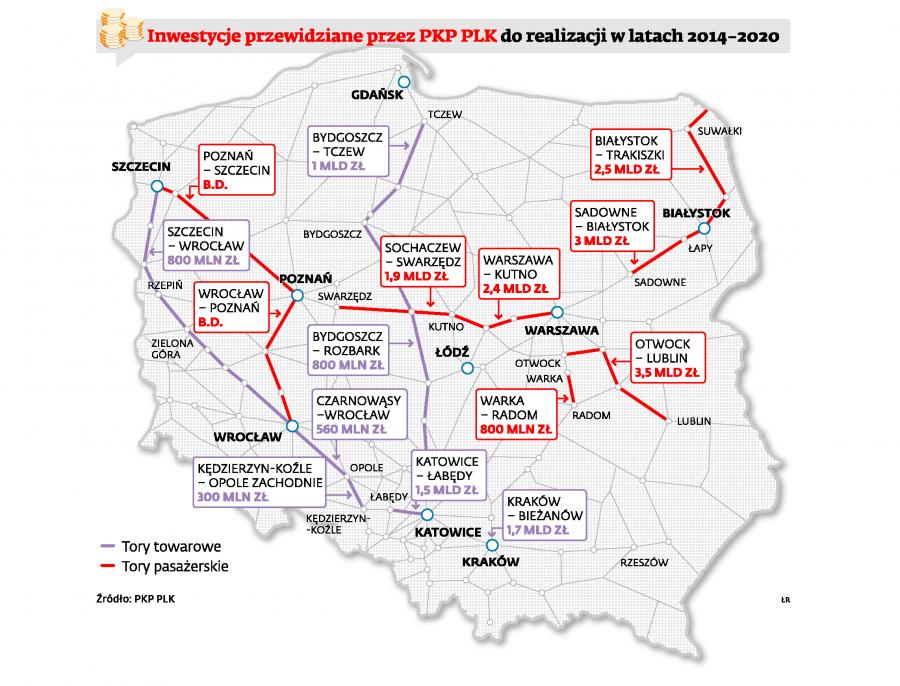
On the other hand the PO government plans for huge highway construction and very small railway improvements in the European Unions perspective 2014-2020 will clearly give buses an advantage in the decade to come, and shows the pro-road stance of the polish government which is against the European Union policy of modal shift towards railways. Just compare the huge highway building program, which spares no expense and will drown Poland under hundreds of billions of debt with the tiny railway program:

Yellow, Red and Blue sections will be finished by 2020 in the map bellow:


Railway investments in 2014-2020:


One more thing which I concluded is that the bulk of the polish long distance rail is TLK trains, InterRegio and EIC trains serve only a fraction of the main destinations, and since TLK is dependent on a ever increasing governmental subsidy and an ever decreasing amount of passengers, it's pretty fair to say that the future of long distance rail in Poland is at the very least highly insecure. With the most popular political party (PO) being staunchly anti-rail, I'm pretty sure that service will greatly decrease in the next 10 years.

sábado, 8 de março de 2014

Russian-Ukrainian conflict

I don't care much about the russian/ukranian conflict, but I'd like to challenge the anti-russian consensus in the west with some different ideas to think of:

1> An interesting read about the subject can be found here: http://lastdayswatchman.blogspot.com/2014/03/putin-doesnt-threaten-our-national.html

2> Territorial integrity is saint? Well, it wasn't seen like that when the USA was bombing serbia to create Bosnia & Kosovo, was it? I fail to see why Serbia had no right to Bosnia where half the population is serbian. Kosovo is mostly albanian, but it has no history what-so-ever as an independent country, it is a completely new creation, a new muslim country in Europe. On whose best interest the on-going support for Bosnia and Kosovo is? Not on the best interest of europeans I'm sure.

3> If Obama (or any other black politician, and yes, even if he lived in a palace obtained through corruption) was deposed, well, I'm pretty sure the streets would be on fire (no, I'm not exaggerating, there are plenty of historical precedents). But somehow the Russians don't have the right to be angry that the western ukrainians deposed the russian-speaking president in Ukraine?

4> Crimea was indeed part of Russia until 1954 when the Soviet Union dictator, a Ukranian at the time, transferred it to the Ukrainian SSR. And the majority of the population is indeed Russian.

5> Sanctions against Russia? When will the EU support the right of armenians in Nagorno-Karabakh to not be ethnically cleansed by the Azeris? When will the EU grow a spine and threaten Turkey for invading and occupying Northern Cyprus, which amounts to occupying land from a member state from the European Union??? If we are pussys enough to do nothing about that, then what is the logic for threatening Russia for invading a country which is merely a possible future member? Ok, we do know the logic behind this, and the logic is: european people that resist the gay-leftist agenda (like Putin) are evil in the liberal world view.

6> The argument that next will be Poland is not a realist reading of the situation. The sphere of Russia with this conflict is decreasing, not increasing. Before Russia had influence in all of Ukraine through the pro-Russian president, now it will have dominium over Crimea, but the rest of Ukraine is now anti-Russian, so he lost territory here, he lots all of Ukraine except Crimea. That's the real reading of the situation. Russia is not expanding, it just decreased it's loss. And how can you claim that someone who is losing parts of his sphere of influence will next attack a NATO backed country for absolutely no reason at all? Poland has no russian minority, and everything that Russia could want from Poland, Stalin already took, like Lviv. Actually if poles were smart they would not be standing against Putin, but instead they would take this opportunity to retake Lviv ;) That is, if poles were interested in that in the first place. The problem of poles is wishing too much that other people have worse (like wishing Putin will get worse), instead of thinking of how themselves could improve their own power ;)

Anyway, now let me analyze the odds that Putin faces. I think that Putin will face an up-hill battle to annex Crimea, because:

a> The crimean tatars (12% of the population in Crimea) hate russians. Update: The new signs are that they will be expelled if they complain too much.

b> They haven't even taken all Ukrainian bases yet, and Ukraine is much larger and militarily powerful than Georgia. Update: From what I am reading, the full take over shouldn't take long by now, they will wait the Ukrainians to be out of food if necessary.

c> Crimea hasn't even declared independence yet Update: now Crimea seams on the fast track for independence (as a russian puppet-state).

d> Even if he wins, International recognition might take a century, see how other conflicts like the Armenian-Azeri one drag for ages without resolution.

I think that the correct position for the EU on the subject should be: Let them sort it out alone. Nothing good has ever come from western interventionism and playing the world cop. At least not since western interventionism became the war machine of the liberal ideology.

The wrong strategy: The Georgian one

Merging this topic with the Georgian-Russian conflict, I think that the war in 2008 shows what will happen to Ukraine if they attack. And that's what happens with nearly everyone which gets in a military conflict with Russia, like Napoleon, Hitler and more recently Georgia, experienced. So that's not the solution. To achieve the objective of keeping it's borders intact, a country which borders Russia needs to be clever as a fox, not pride as a lion.

Going out of the original topic a but, one strange thing is that I don't even fully understand what Russia has to win in the conflict with Georgia: why it supports so badly Abkhazia and South Ossetia? The best explanation that I read is because Abkhazians lobbied themselves as pro-russians, although this is kind of silly as they obviously are interested in nothing but themselves. But in the Ukrainian case Russia has a lot more at stake, Crimea is indeed a russian-majority area, and 30% of the population in Ukraine has russian as native language.

Abkhazia and South Ossetia do not pass the test of deserving their own country in my opinion. South Ossetia is not even economically viable, it has only 55.000 inhabitants compared to 700.000 in North Ossetia, and that the Ossetians are split among 2 countries, will that's the case for so many other ethnic groups that I can't even count. And Abkhazians were only 25% of the population in their region before they ethnically cleansed the place, and their country didn't exist for centuries, so just the fact that they killed and expelled so many georgians just makes them undeserving.

The right strategy: The Kazakh one

While the Georgian strategy shows how not to deal with Russia, the Kazakh one shows how to correctly deal with Russia. Georgia is 100% correct to wish to have its borders restored, but in my opinion they had very bad strategies to achieving this. They did not lobby themselves as pro-russians, they lost several wars against weak enemies, tried to join NATO before securing their borders (which is something not realistic and only worked to further make Russia fell threatened, and threatened bears attack!). Now look at Kazakhstan: There is a large number of russians in north kazakhstan, enough to make it a good prize for Putin, but there both countries are like the closest friends ever! The Kazakh president even supported Putin's actions in Crimea, even if they are against the interests of tatars which are related to kazakhs! [source] So that's the correct way to be a good close neighbour of Russia: Don't threaten Russia, agree with everything Putin says, and live nicely. In the long run victory will be achieved by slowly increasing control over the border regions, like the number of russians drops each year in Kazakhstan.

If Ukrainians didn't try to force their way they could have increased control over Crimea slowly over the years until such an invasion would be simply not viable in a future were most inhabitants of the peninsula would be ukrainians. On the other hand it can be claimed that this move by Russia could not have been predicted, at least I didn't think that Putin go for Crimea.

sexta-feira, 14 de fevereiro de 2014

The end of passenger rail in Poland

I think we can officially announce that passenger rail in Poland lost it's position as the dominant alternative to car transportation.

A few years ago passenger rail was the dominant alternative to car transportation by far. A system which I utilized nearly exclusively for traveling all around Poland, and much beyond. I traveled from Lwów to Kraków to Warsaw to Gdańsk. I really loved this rail system, and specially traveling in the night cars. And everything so cheaply. The German real system is even better, but it is so expensive, they really eat all your euros to use the wonderful railways. In Poland I had not that much less quality for so much less money.

But nowadays, in 2014, I can see that this system has started a death spiral, and I don't find it probable that it will escape and remain a great system like passenger rail remains in Germany. Instead I think that the current course will lead the polish passenger rail into a tiny niche marker, with connections to most cities closed and pricy tickets, like in the United States.

Here are the facts:

1> The PO - Tusk - polish government is planning to cut 10% of long distance trains. [source]
2> The PO - Tusk government has set the railway and highway usage fees in such as way as to promote bus operators and destroy passenger rail. There is no logical way that passenger trains can compete in price with bus operators such as Polski Bus, because a train going from Wrocław to Katowice has to pay around 800zł in track usage fees while PolskiBus pays 16zł for using the highways. [source] The European union has already denounced this track usage fees as being unacceptable, as they are the highest in Europe, and they are destroying the polish railways and the European Union forced the polish government to reduce the track usage fees. The PO - Tusk government then complied, but they at the same time increased the rail station usage fee, so as to effectively keep almost the same price for passenger rail. Only for cargo operators the fee decreased significantly.
3> Every single zł invested by the PO - Tusk government in rail is because they are forced to do so in order to receive the European Union non-refundable funds. Tusk already tried at least 5 times to convince the EU to stop giving rail investment money to Poland, he wanted to transfer the money to road projects, but the EU refused again and again and again. [source 1] [source 2]
4> The PKP Intercity plans for the future are absurd, focused in the extremely expensive Pendolinos, bought with debt which will make the company bleed money to pay the interest rate. The Pendolinos will travel from 120 to 240 km/h, so nothing special, and will have very expensive tickets, which means that most people will not use them, but instead will use buses. PKP Intercity has no strategy for international, long distance and night trains in general, except waiting for them to die.
5> The other concurring company, Przewozy Regionalny, is in it's own death spiral. It has huge debts due to huge track usage fees and it's owners (the polish states) are constantly fighting with one another which assures that the company will never receive investment. So it has no future and is destined to die.
6> Private operators will only take the most popular routes like Katowice-Warsaw and Poznan-Warsaw and never run in the rest of the country.

My conclusions of this are:

1> The current polish government hates passenger rail and will do everything possible to destroy the polish passenger rail.
2> There is no turn back and there is no point in fighting against it (it would just be a waste of my time and my energy). It's the policy of the current government, and I don't see they going out any time soon. PiS might have good poll numbers, but I don't believe they will come to power, I bet that the liberal media will make a huge defamation campaign as always and save the liberal government. So this makes sure that there will be no policy change here, and the course will be kept steady in killing passenger rail.
3> I won't migrate to buses, as I hate buses, they have no leg space, they shake a lot (which sickens me if I try to work in a bus, but in a train I can work for hours). In general buses are an uncomfortable crappy 3rd world transport system. I think that the only way to move around Poland with comfort will be in a car from now on.

Now a comparison of the costs of bus and rail running:

Costs of a bus operator in Poland:

1> First the investment cost is 1,7 million zlotes for each new PolskiBus bus [source]
2> It burns 25L per 100 km, so 80 zl in fuel per 100 km
3> They pay their drivers a minimum wage, which costs for the employer around 2.000 zl per month (1600zl per month brutto + ZUS surcharges), which means 2000/160 => something like 15 zlotes per driving hour after counting some hours more due to stay in bus station, traffic jam, etc.
4> Krakow-Katowice costs 30 zl for one way
5> Two kinds of bus: Altano with 70 sitting places and Astromega with 2 floors and 90 sitting places.
6> Around 25zl per each parking in a bus station

Comparison of Kraków-Katowice:

A rail operator will have to pay around 400zl only for rail access + at least 300zl for energy + 100zl for personal + 200zl for railway station fees: Total cost of 1000zl which it needs to cover from tickets. If the tickets cost 10zl each, it will need at least 100 passengers to cover operational costs.

A bus operator will pay 30zl highway+80zl fuel+15zl for driver+50zl for bus station =170zl. If he fills 50 places, he can sell at 4zl each and still make an operational profit.

Comparison of Katowice-Wroclaw:

A rail operator will have to pay around 800zl only for rail access + at least 600zl for energy + 200zl for personal + 200zl for railway station fees: Total cost of 1700zl which it needs to cover from tickets. If the tickets cost 20zl each, it will need at least 85 passengers to cover operational costs.

A bus operator will pay 30zl highway+160zl fuel+30zl for driver+50zl for bus station =270zl. If he fills 50 places, he can sell at 6zl each and still make an operational profit. But he also has to pay for the bus debt, for administration, for insurance, etc.

Conclusion part 2> The railway access fees in Poland are ridiculously high, they are 10 times higher than in Spain, while the Highway access fees are very cheap for buses, so passenger trains cannot possibly be competitive and this is a deliberate Tusk policy to destroy the rail transport system. Even the European Union recognized that and already tried to force PLK to decrease its fees, but it responded by increasing train station fees.

Dumping bus prices

Even with my calculations above, and they more like guessing as I don't know the real costs involved, I am left thinking that the scotish billionair owner of PolskiBus and other companies are doing Dumping, as his prices are way bellow anywhere else in the world. In Spain to go 150km by bus will cost you at least 10 euros, but Katowice-Kraków is 6zł o.O

In Brazil the bus Piracicaba-Sao Paulo (165km) costs 40 reais, which is 55 zł only 1 way and there are no promotions at all.

In England I searched for London-Liverpool (300km) and the cheapest is 15 pounds (75zł). There is no free lunch, unlike in Poland, while PolskiBus does Wrocław-Kraków (270km) for 16zł regularly, buying in the same day.

Rail Usage Statistics

We will be able to watch if my conclusions are correct in the official European Union statistics in the next hears, here is the website: http://appsso.eurostat.ec.europa.eu/nui/show.do?dataset=rail_pa_total&lang=en

Here is a graphical representation of the data currently available there:


It is hard to see Poland when compared to Germany, UK, France and Spain, so here is another chart which zooms into the countries with less ridership:


Well, looking at the chart I guess it could be worse (like Romania). But the fall in long distance passengers is real, PKP Intercity lost 16% of it's passengers in 2013 [source], what kept the numbers not that bad for Poland was regional rail, which is growing specially around Warsaw.

It is also interesting to keep in mind the list of 58 projects for 2014-2020 the new European Union investment perspective: http://www.rynek-kolejowy.pl/49166/58_projektow_na_przyszla_perspektywe.htm and also here a copy of the official document which seams to have been taken offline: http://media.wix.com/ugd/0a3577_20398b09eea346b1add942b5b6e9dca7.pdf

Which is really tiny in comparison with the huge highway building program in Poland, and such politic will give road transport a key advantage in the next decade:


sábado, 11 de janeiro de 2014

O Tesouro Direto está cada vez melhor com a subida dos juros

E está cada vez melhor a situação no Brasil pra quem investe no tesouro direto. A única questão é quando é que vai ser o melhor momento para comprar? Difícil saber, pois quanto mais os juros sobem, melhor fica e quem comprar agora pode perder a oportunidade de comprar mais barato ainda no futuro ... mas por outro lado se a situação reverter pode perder essa oportunidade. Eu acho que vale a pena esperar o aumento dos juros em 15-16 de janeiro na reunião do Copom. Se eles aumentaram em 0,5% os juros eu acho que a NTN-B pode chegar a até 14%!


Fonte: http://www3.tesouro.gov.br/tesouro_direto/consulta_titulos_novosite/consultatitulos.asp

quinta-feira, 9 de janeiro de 2014

Jesus on Gay "Marriage"

Related to this: http://orthosphere.org/2014/01/07/consider-the-options/#comment-31966

Jesus on Gay Marriage:

Matthew 5: 17, 18 "Do not think that I have come to abolish the law or the prophets; I have come not to abolish but to fulfill. For truly, I tell you, until heaven and earth pass away, not one letter, not one stroke of a letter, will pass from the law until all is accomplished."

And then when you read up the law you see:

Leviticus 18:22 "You shall not lie with a male as with a woman; it is an abomination. Also you shall not have intercourse with any animal to be defiled with it, nor shall any woman stand before an animal to mate with it; it is a perversion."

Leviticus 20:13 "If a man has sexual relations with a man as one does with a woman, both of them have done what is detestable. They are to be put to death; their blood will be on their own heads."

Not to mention apostolic writings:

I CORINTHIANS 6:9-11 "Or do you not know that the unrighteous shall not inherit the kingdom of God? Do not be deceived; neither fornicators, nor idolaters, nor adulterers, nor effeminate, nor homosexuals, nor thieves, nor the covetous, nor drunkards, nor revilers, swindlers, shall inherit the kingdom of God. And such were some of you; but you were washed, but you were sanctified, but you were justified in the name of the Lord Jesus Christ, and in the Spirit of our God."

I Timothy 1:9-10 9realizing the fact that law is not made for a righteous person, but for those who are lawless and rebellious, for the ungodly and sinners, for the unholy and profane, for those who kill their fathers or mothers, for murderers 10and immoral men and homosexuals and kidnappers and liars and perjurers, and whatever else is contrary to sound teaching,"

And lets not forget the connection between gay "marriage" and pedofily:

www.midiasemmascara.org/arquivos/6164-pedofilia-ja-enquanto-ainda-estou-com-tudo-em-cima.html

http://rt.com/news/pedophile-syndicate-russian-boy-481/

http://www.dailymail.co.uk/news/article-2393693/How-love-gay-couple-adopted-14-year-old-boy-29-foster-homes-mental-institution-helped-teenager-overcome-troubles-inspired-to-college.html

http://gothamist.com/2013/04/07/gay_couple_accused_of_raping_multip.php


http://www.newsninja2012.com/they-took-turns-raping-me-over-and-over-conneticut-kids-tells-police-of-gay-couple-who-will-face-trial/

domingo, 29 de dezembro de 2013

My opinion on Genderism

http://www.naszdziennik.pl/mysl/63235,list-polskich-biskupow-i-nowa-teologia-wyzwolenia.html

This sunday the polish Catholic church read a letter against the genderists, like the "gay movement".

I personally think they are wasting their time. 1 single letter in 1 sunday cannot possibly compete against everyday brain washing done by the leftist/liberal/genderist media like Gazeta Wyborcza and Newsweek, which simply controls what most people believe in. The polish Catholics are simply attracting the hate attacks of the leftists to themselves. Just like Al Qaeda wouldn't tolerate any deviation from their vision, the leftists won't tolerate dissidence either, and they are well funded and control most of the media.

And we cannot forget: who is one of the greatest genderists in Poland? Tusk, read this:

http://wpolityce.pl/wydarzenia/62248-jak-reaguja-dzieci-na-program-rownosciowe-przedszkole-chlopcy-gryza-i-placza-nie-chca-ubierac-sie-w-dziewczynskie-rzeczy

http://wpolityce.pl/wydarzenia/63106-ideologia-gender-po-przedszkolach-wciska-sie-do-szkol-podstawowych-my-rodzice-musimy-sie-jakos-temu-przeciwstawic

That's what he does when he is not busy increasing taxes or stealing us.

Tusk's message for a good 2014: Help us build the incredible new genderist world, keep voting PO, and while you are doing it, please empty your wallets, I'll take care of spending your stuff

domingo, 22 de dezembro de 2013

Caças de 4a Geração e a escolha do Gripen NG para a FAB

Imagem: Gripen NG

Recentemente saiu a notícia de que o governo brasileiro escolheu finalmente o novo caça da força aérea brasileira que irá substituir os Mirage 2000 comprados usados da França e os F-5 muito velhos que temos atualmente. Há mais de 10 anos que a escolha do novo caça brasileiro se arrasta, assim eu gostaria de discutir aqui as opções que foram levantadas e os prós e contras de cada uma e chegar a uma conclusão se a escolha foi boa ou não.

Os três concorrentes principais foram o F/A-18 americano, o Rafaele francês e o Gripen NG suéco. No início do processo ainda foram considerados o Sukhoi russo e o Eurofighter inglês, mas estes foram discartados há muito tempo. O Eurofighter é muito caro, assim não seria uma boa escolha, mas não sei ao certo porque o caça russo foi descartado tão cedo.

Para a escolha é importante saber qual o objetivo de gastar dinheiro, algo que está sempre em falta, e que poderia ser gasto em tantas outras coisas mais necessárias, como hospitais e escolas, em aviões de guerra. Mesmo o Brasil estando numa região pacífica, onde há muito tempo não há guerras, ter forças armadas para garantir a paz por simplesmente possuir um poderio militar que coíba uma eventual invasão é indispensável. Oras, se até a neutra Suiça cercada de países amigaveis tem uma força armada nada desprezível, quanto mais o Brasil, que tem recursos naturais riquíssimos e tem na sua fronteira loucos como o cocaleiro Evo Morales da Bolívia e os chavistas na Venezuela, precisa ter uma defesa de respeito.

Comparação dos Aviões

Tendo em vista que é importante ter um caça moderno, o objetivo principal mais específico desse caça seria primeiro de tudo interceptar aviões inimigos e estabelecer a superioridade aérea. Por isso ao comparar os caças eu procurei saber se eles de fato tem vitórias comprovadas no combate ar-ar, o que mostra que não são apenas brinquedos caros, mas sim ferramentas de guerra de eficácia comprovada. E secundariamente o caça deveria ser capaz de realizar todas outras tarefas de avião, como bombardear alvos no solo, lançar mísseis ar-terra e ar-mar, realizar o reconhecimento no território inimigo, etc. Em fim, procura-se um avião que faz de tudo, mas que acima de tudo deva interceptar aviões inimigos. Dos caças considerados os únicos com vitórias ar-ar contra outros caças são o F/A-18 e o Sukhoi. Não há mais guerras entre países desenvolvidos, assim os caças acabam nem tendo a chance de ser usados para se provar, pois enfrentam inimigos tão inferiores que nem oferecem muita resistência como a Líbia na recente Guerra da Líbia aonde o Rafaele abateu aviões a hélice de transporte desarmados e o Gripen participou de bombardeios. O armamento do Rafaele por outro lado é de comprovada eficácia, em 1996 um Mirage 2000 grego abateu um F-16D turco com um míssel francês R550 Magic II, assim os mísseis franceses podem abater até mesmo caças americanos! Já o Gripen NG vai usar usar armamento americano, o mesmo do F/A-18.

Além disso, também é importante pensar no preço, já que mesmo os chavistas e cocaleiros teriam que ser muito loucos de atacar o Brasil, e o orçamento federal está sempre apertado, é importante que o caça não seja caro de comprar e nem caro de manter. Nesse aspecto o Eurofighter peca, pois é o mais caro. O Rafaele em todos outros quesitos é excelente, mas no preço ... realmente eu concordo com o governo brasileiro ao dizer que o preço do Rafaele é muito salgado. O Gripen NG é de longo o mais barato, mas ele também é muito menor que os outros e carrega menos armas.

Um outro aspecto ainda é a transferência de tecnologia que permitiria construir partes do caça no Brasil e se encaixar na produção do mesmo não apenas para as compras brasileiras, mas idealmente para as compras futuras do caça por outros países no mundo tudo. Isso pode parecer não ter muito a ver com defesa, mas pelo contrário, tem tudo a ver. No caso de uma guerra real, uns poucos caças não bastariam, seria necessário ter muitos mais, até centenas, e o único meio confiável de ter centenas de caças sem depender de um aliado benevolente e o país saber fabrica-los ele mesmo. Além disso é obvio que os empregos gerados no Brasil e o PIB gerado também são benefícios extras.

Na tabela abaixo temos uma visão geral comparando os aviões que foram considerados no processo, mostrando os quesitos que mencionei anteriormente: preço unitário, o custo operacional, a tecnologia, a carga de mísseis e as vitórias ar-ar do caça (ou outros semelhantes).

AviãoPreçoCusto operacional de 1 hora de vôoTecnologiaCarga de mísseis e bombasVitórias ar-ar em combate
Boing F/A-18 Super Hornet
70M $US
11 mil US$
Comprado como produto pronto dos EUA sem possibilidade de transferir tecnologia ou construir partes
7,5 tons
F-18 abateram vários Migs iraquianos na Guerra do Golfo I (1991) [fonte]
Dassault Rafaele90M $US
16 mil US$
Motor (Snecma M88) e armamentos franceses, com possibilidade de construir partes no Brasil, assim poderia ser exportado para qualquer país
10 tons
Alguma experiência na Guerra da Líbia, os mísseis franceses são muito bons
Saab Gripen NG
55M $US
5 mil US$
O Brasil construiria 40% do avião com transferência da tecnologia sueca e projeto de partes aqui, mas o motor e os armamentos são americanos
3 tons
Nenhuma, experiência na Guerra da Líbia
Sukhoi Su-35
65 $US
?
Tecnologia russa
6.5 tons
Su-27 da Etiópia abateram 3 Migs da Eritréia 
Eurofighter Typhoon
115M $US
18 mil US$
Tecnologia principalmente inglesa, mas também alemã, italiana e espanhola
5 tons
Nenhuma?
Fonte: [1] [2]

Conclusão

Acredito que a melhor escolha para a defesa nacional seria mesmo o Rafaele, mas ele é realmente caro e não sei se o Brasil realmente poderia entrar na cadeia de construção dele para exportação, já que ele é um projeto pronto já em construção. Já no Gripen NG o Brasil vai entrar quase que de igual para igual como um parceiro para desenvolver o avião. Nesse mundo pós-crise mundial o Gripen é muito competitivo e pode se tornar bastante popular entre países sem perspectiva de guerra. O Gripen NG foi escolhido recentemente pela Suiça, que não tem nenhuma ameaça militar em vista e pode ainda ser exportado para outros países em situação similar como a Nova Zelandia. Esses países devem preferir o barato Gripen ao caro Rafaele. Em países que tem perigo mais real de guerra acredito que o Rafaele deva ser preferido. Por outro lado a desvantagem do Gripen é que ele é baseado num motor e em mísseis americanos, assim ele não pode ser exportado para países inimigos dos EUA como a Venezuela que são grandes compradores de armas.

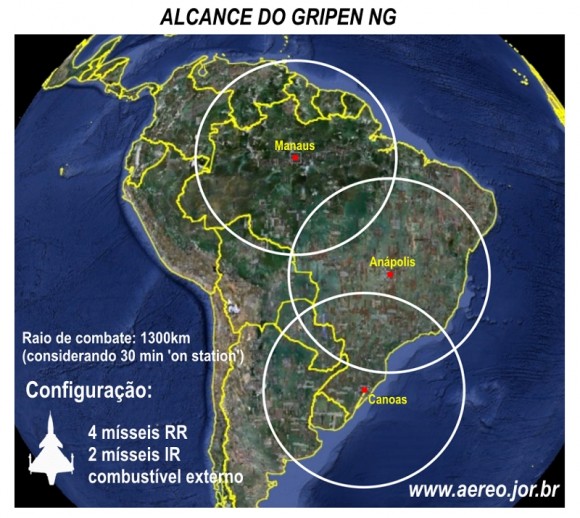
O Gripen foi muito criticado devido ao seu baixo alcance, de cerca de apenas 800km na versão anterior. Isso se deve ao fato de que ele foi desenvolvido para as necessidades de um país pequeno, a Suécia, e o tornaria quase inútil num país continental como o Brasil. Mas pelo que entendi essa crítica já foi rebatida e o Gripen NG é um projeto em desenvolvimento que foi revisado para ter um alcance de 1300km sem tanques externos ou 4000km com tanques externos para se adequar as necessidades brasileiras. [fonte] Veja ainda a imagem do raio de alcance do Gripen NG a partir das bases brasileiras. Bom, é um pouquinho curto, mas acredito que isso poderia ser corrigido com uma base no Acre e outra em Natal no nordeste. O alcance do Rafaele de fato é maior, mas creio que tais bases seriam necessárias de qualquer modo, para os aviões não terem de voar no máximo de seu alcance.


Bom, concluo que a escolha realmente estava difícil e que não há uma opção única que é melhor em todos quesitos, mas acho que a escolha será boa para a Embraer e a indústria brasileira, assim acho que de modo geral a escolha foi boa. Tanto o Gripen quanto o Rafaele seriam escolhas boas.